
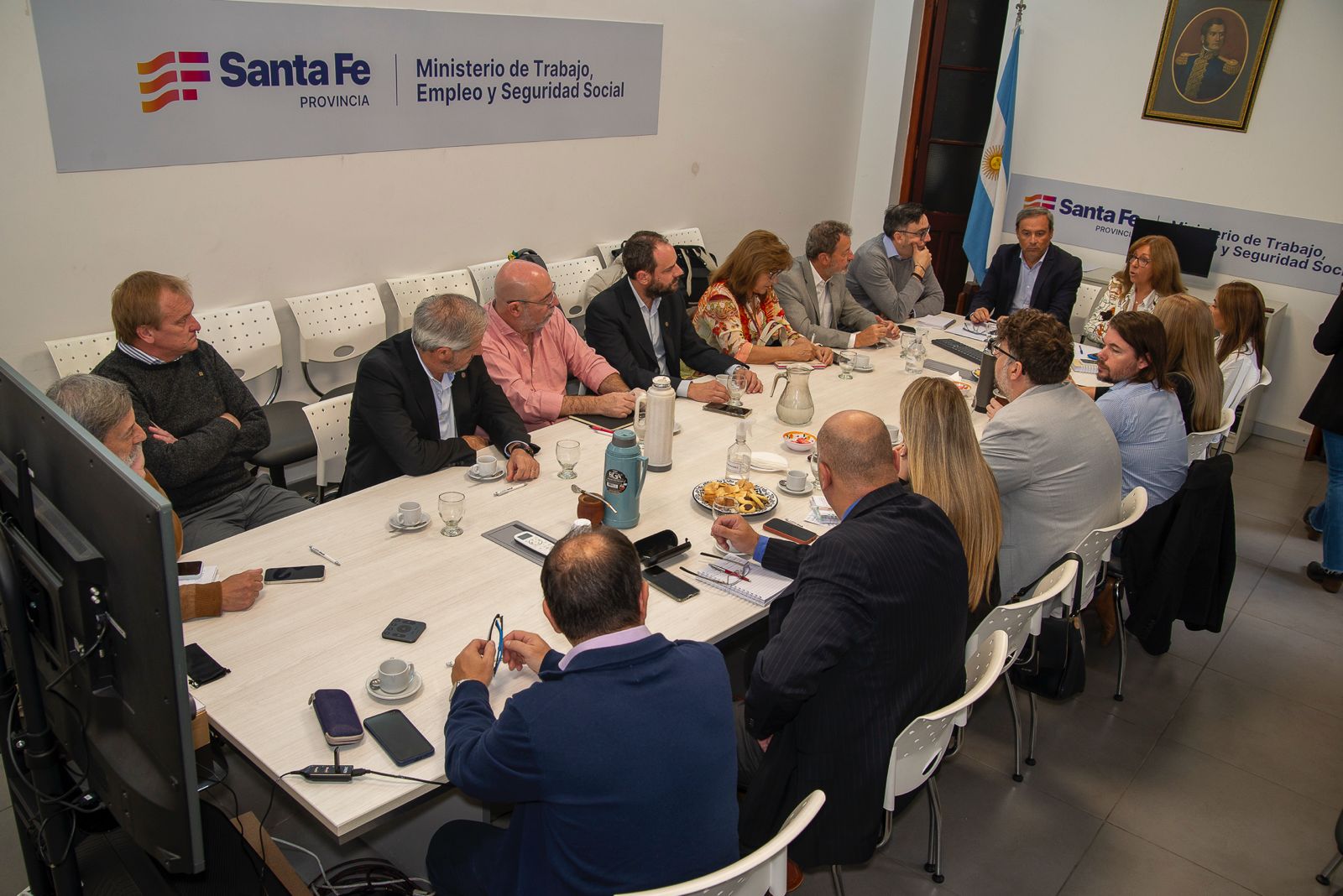
The Government of the Province of Santa Fe has formally established the local Advisory Council of the Observatory on the impact of technology and artificial intelligence (AI) on employment in the Central Region. The meeting took place at the headquarters of the Ministry of Labour, Employment and Social Security in the provincial capital, and brought together government officials and leading figures from the academic world.
The initiative aims to establish a forum for technical and academic analysis to support the transformations in the labour market in the face of the advance of AI. The event was led by the Secretary of Government, Juan Cruz Cándido; the Secretary for Coordination and Institutional Relations at the provincial Ministry of Labour, Gustavo Zignago; and the pro tempore coordinator of the Executive Committee of the Central Region, Claudia Giaconne.
Zignago highlighted that the inclusion of universities on the Advisory Council aims to “generate reliable evidence to guide public decision-making in the face of the uncertainty posed by new technologies in the labour market”. In the same vein, the Vice-Chancellor of the National University of the Littoral (UNL), Liliana Dillon, emphasised the value of joining the Observatory “to contribute to the design of public policies that respond to the challenges of the new world of work”.
For his part, Horacio Alesandria, a representative of the Catholic University of Santa Fe (UCSF), noted that the aim is “to coordinate efforts between the academic sector and the state to address the impact of artificial intelligence on both employment and vocational training”.
Regional assessment
The Council was established as part of the presentation of the results of the first regional study on the impact of AI, conducted between July and August 2025. The survey covered more than 2,400 businesses – including entrepreneurs, small and medium-sized enterprises, and large companies – in Santa Fe, Córdoba, and Entre Ríos.
The data reflects a transitional scenario: 30% of companies are already implementing artificial intelligence tools or plan to do so within the next two years, mainly in areas such as data analysis, marketing, and customer service. At the same time, 35% are in the evaluation phase, whilst another 35% do not envisage adopting them in the short term, with a greater presence in sectors such as construction, agribusiness, and commerce.
Challenges and training
One of the report’s key themes is the perception of employment. Forty-five per cent of business leaders believe that AI will not replace jobs, although it will change job roles and profiles. However, the study highlights a skills gap: half of those surveyed rate their teams’ readiness to adapt to these technologies as low.
Key findings include uncertainty regarding the actual impact on employment, the difficulty in finding qualified candidates, and the need to strengthen training in digital skills, with the aim of reducing internal resistance within organisations.
Institutional Coordination
Also attending the meeting were the Under-Secretary for Strategic Management, Paz Gutiérrez; the Under-Secretary for Public Innovation, Juan Martín Atencio; and the Director of Planning and Statistics, Mariano Giunta. Representing Entre Ríos were Ricardo Juncos and Sofía Schönhals from the Secretariat of Labour and Social Security.
From the academic sector, officials from the UNL, the National Technological University (UTN) Santa Fe Regional Faculty and the UCSF were present, alongside deans and heads of research, technology liaison, and vocational training departments. The participation of these institutions reinforces the focus on coordination between the public sector and the university system to address the challenges posed by the digital transformation of work.